Technical Report: The Modern Embedded Systems Paradigm
1. Executive Summary
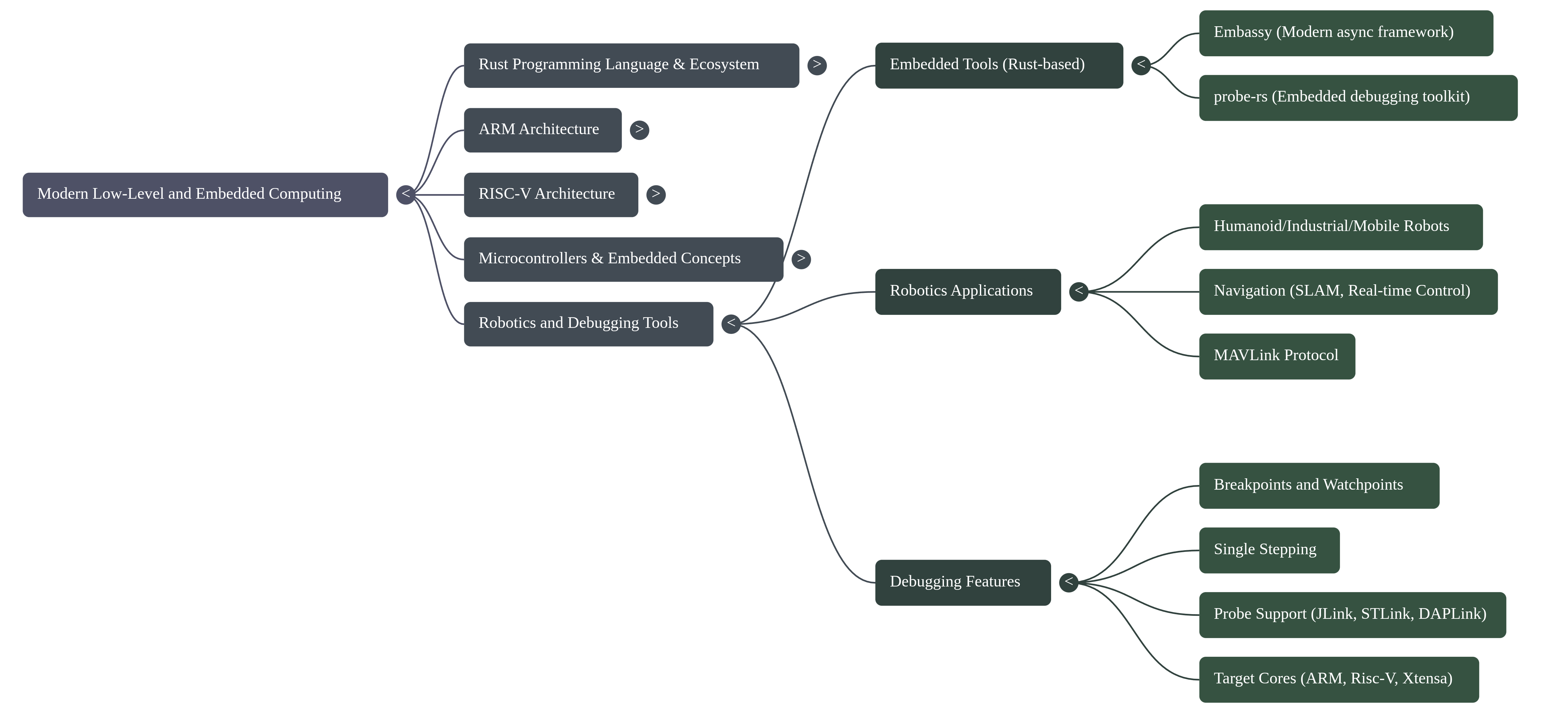
Modern embedded systems development is strained by a fundamental tension: while hardware complexity explodes, the traditional C/C++ development paradigm offers insufficient compile-time guarantees against critical memory and concurrency failures. A fundamental paradigm shift is underway to address this, moving away from legacy approaches toward a powerful synergy between advanced hardware architectures and modern, memory-safe programming languages. This shift is defined by the adoption of high-performance languages like Rust, known for its core tenets of building reliable and efficient software, in concert with sophisticated processor architectures such as ARM and RISC-V.
Frameworks like Embassy are emerging to leverage this new paradigm, enabling developers to write safe, correct, and energy-efficient embedded code using Rust's advanced async capabilities. The strategic application of these modern language features provides compile-time guarantees against entire classes of common and dangerous bugs, such as memory errors and data races, which have historically plagued embedded development.
This report analyzes the core technical pillars that underpin this modern paradigm: foundational safety, hardware abstraction, performance optimization, and the developer ecosystem. It will deconstruct the implementation methodologies that bring these pillars to life and examine the inherent challenges and limitations that engineers must navigate in this demanding field.
2. Core Technical Pillars
The modern embedded paradigm is built upon several foundational technical pillars that collectively address the core challenges of safety, abstraction, and performance. This new model does not treat these concerns as separate; instead, it integrates them through a combination of language design, hardware architecture, and a robust developer ecosystem. This section deconstructs these essential pillars.
2.1 Pillar 1: Foundational Safety and Reliability
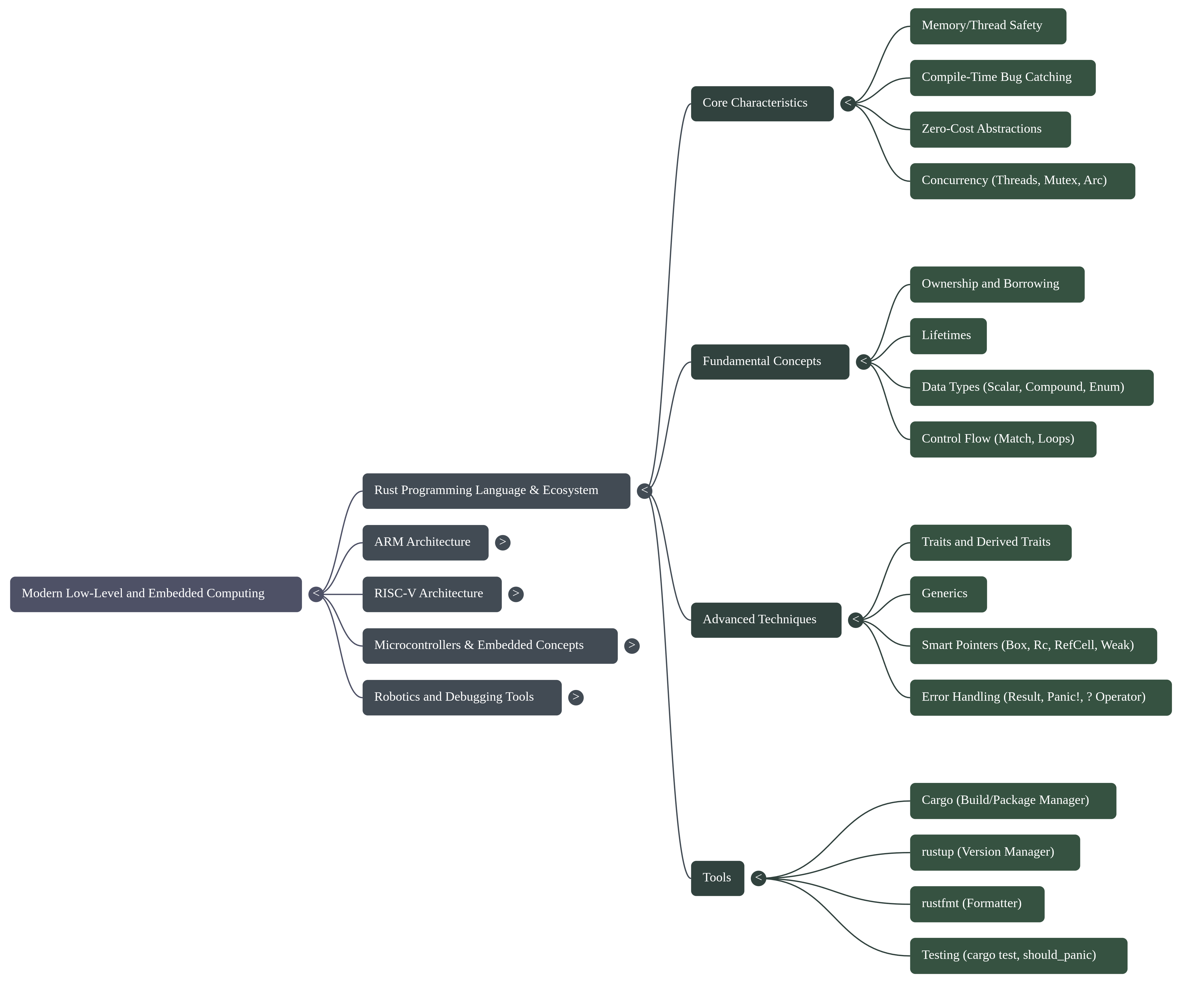
In embedded systems—where software failure can lead to equipment damage or risk to human life—memory and concurrency safety are paramount. The adoption of modern languages is driven by the ability to provide these safety guarantees without sacrificing performance. Rust, in particular, provides these guarantees at compile time, eliminating entire classes of bugs before the code is ever deployed to a device.
- Memory Safety: Rust's ownership and borrowing model is a cornerstone of its safety guarantees. It enforces strict rules at compile time that ensure there is only one owner of a piece of data, preventing common errors like dangling pointers, buffer overflows, and use-after-free vulnerabilities. Crucially, this is achieved without a garbage collector, making it perfectly suited for resource-constrained, systems-level work where deterministic performance is essential.
- Thread Safety: With the rise of multi-core processors in embedded systems, managing concurrency safely is critical. Rust's type system extends its ownership model to multithreading, preventing data races at compile time. This compile-time guarantee is a revolutionary departure from traditional approaches that rely on runtime detection or developer discipline, which are inadequate for the complex Symmetric Multi-Processing (SMP) systems now common in embedded applications.
- Robust Error Handling: Traditional error handling, often relying on null
pointers or error codes, can be easily overlooked by developers. Rust uses a
Result<T, E>enum, which forces the developer to explicitly handle the possibility of failure. This ensures that errors are acknowledged and managed, leading to more robust and predictable software.
2.2 Pillar 2: Abstraction and Direct Hardware Control
Embedded systems engineering presents a unique duality: developers need high-level abstractions to manage complexity, but also require direct, low-level control over the underlying hardware. The modern paradigm addresses this by providing tools that can operate at both levels of abstraction, built upon a deep understanding of the hardware components.
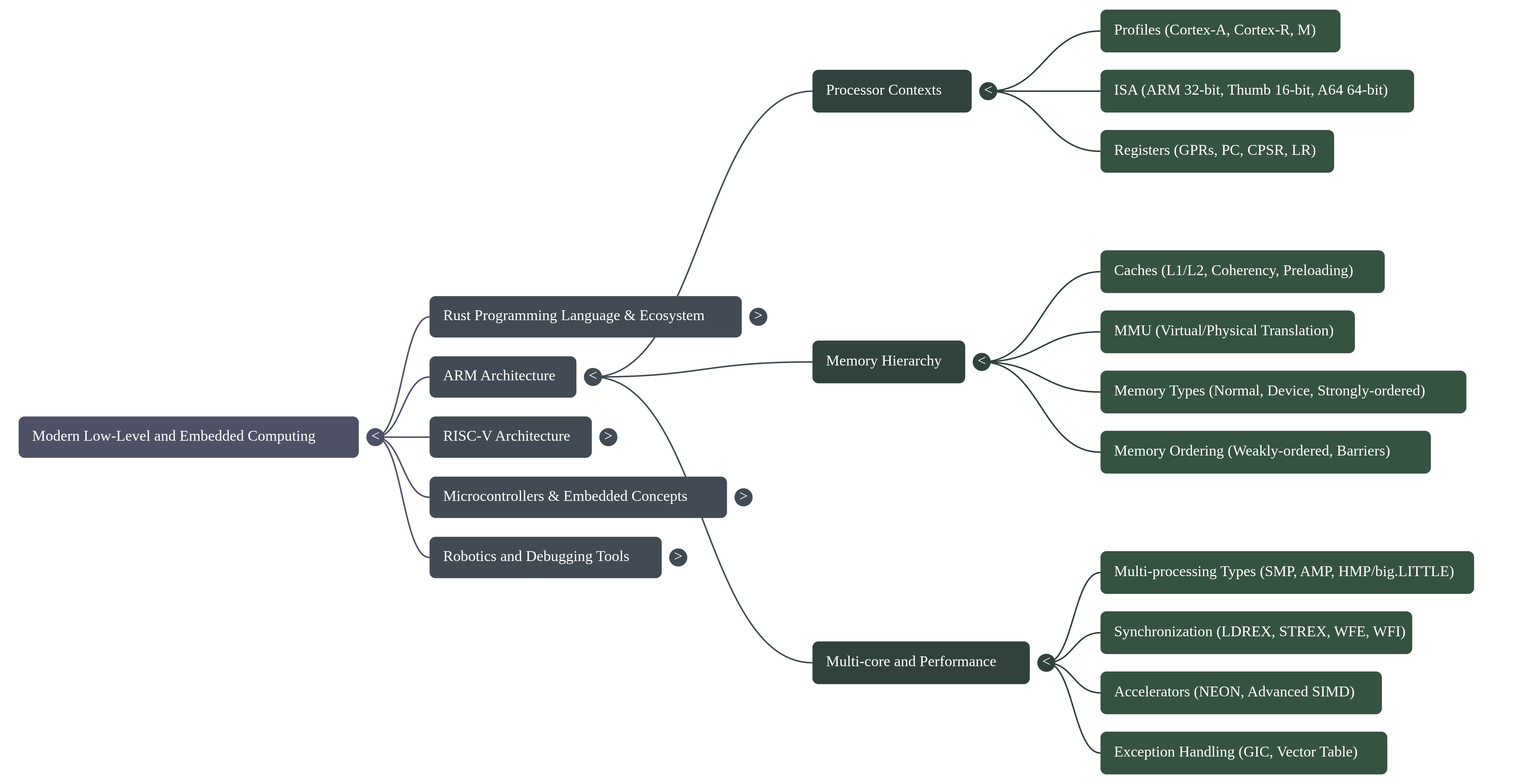
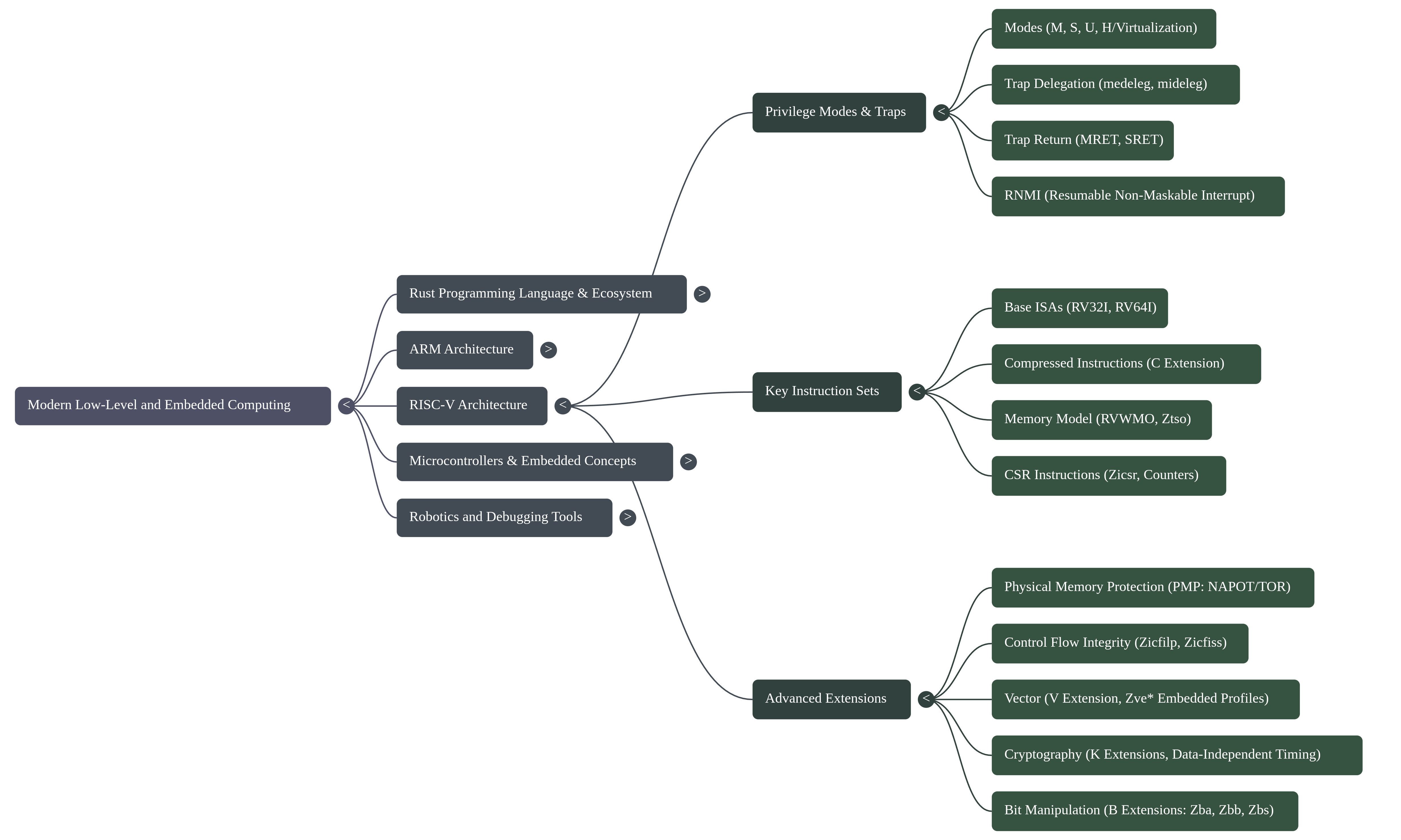
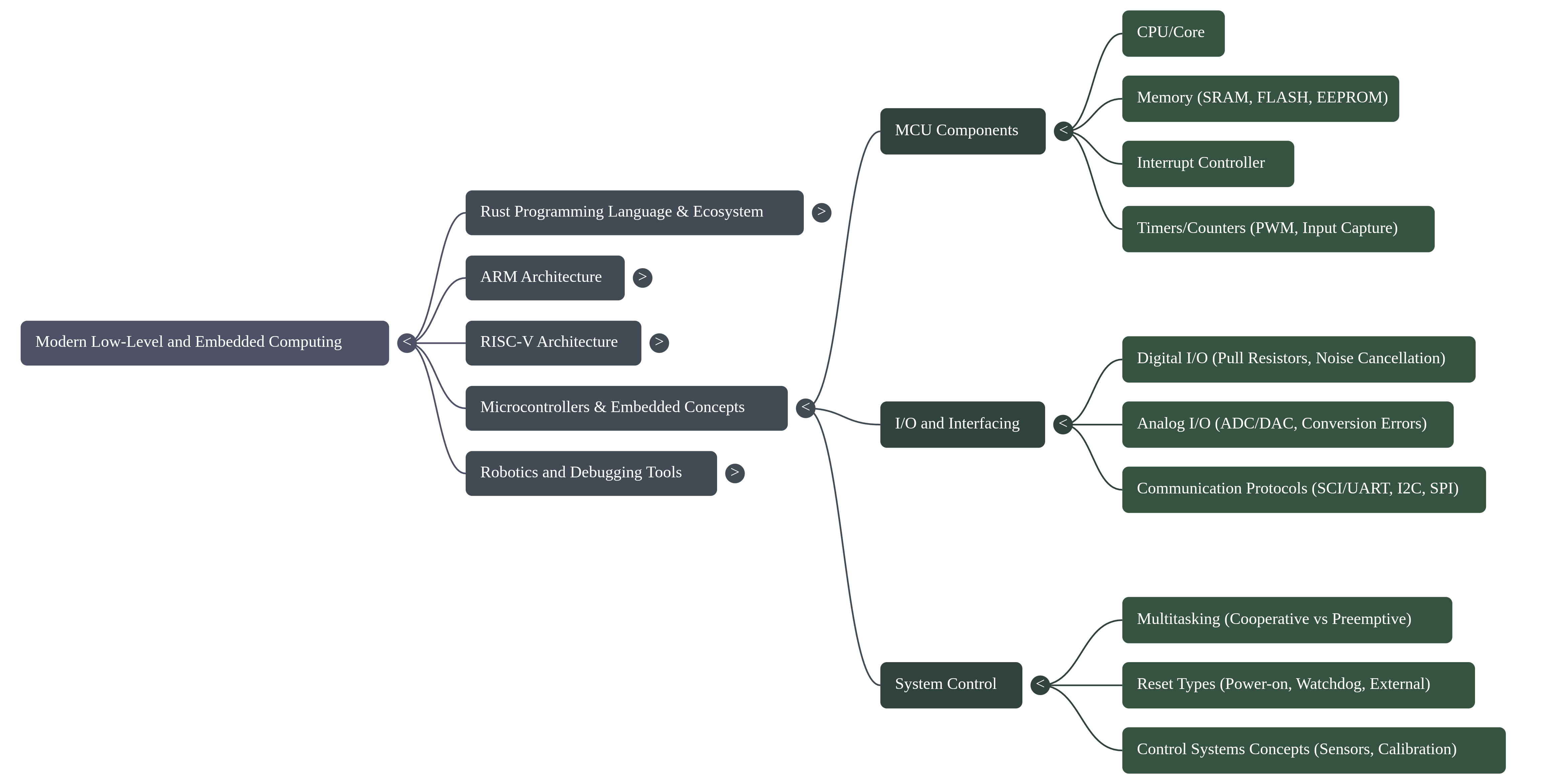
-Microcontroller Architecture: A microcontroller (MCU) is a self-contained computer on a single chip, designed for control tasks. It integrates a processor core (CPU), memory, I/O peripherals, timers, and an interrupt controller. This integration allows it to operate stand-alone, directly interfacing with its environment through general-purpose I/O pins. -Processor Cores: The dominant architectures in this space are ARM and RISC-V. Both are based on Reduced Instruction Set Computer (RISC) principles and are load/store architectures, meaning that arithmetic and logic instructions operate on registers, and only specific load and store instructions access memory. The ARM architecture is further divided into profiles tailored for different applications, such as the Cortex-A series for high-performance applications and the Cortex-R series for real-time systems. These cores can operate in different execution states, such as the 32-bit AArch32 or the 64-bit AArch64 state. This profile-based specialization allows hardware to be precisely tailored to an application's cost, power, and performance envelope, ranging from high-throughput application processors to fault-tolerant, deterministic real-time controllers. -Memory Systems: Embedded systems utilize a hierarchy of memory types. This includes fast but volatile Static RAM (SRAM) for data, and non-volatile Flash or EEPROM for program code and constants. High-performance systems, particularly in the real-time Cortex-R family, also feature Tightly Coupled Memory (TCM) for deterministic, low-latency access—a critical feature for hard real-time tasks where the non-deterministic latency of cache hierarchies is unacceptable. More complex Cortex-A processors include multi-level caches (L1/L2) and a Memory Management Unit (MMU) to translate virtual addresses generated by the core into physical memory addresses. -Peripherals and Communication: Software must directly control a wide range of on-chip peripherals to interact with the outside world. Common peripherals include General-Purpose Input/Output (GPIO) pins, Pulse Width Modulation (PWM) for controlling motors, and Analog-to-Digital Converters (ADC) for reading sensors. Communication is handled via standard protocols like I2C, SPI, and UART.
2.3 Pillar 3: Performance and Optimization
Performance and energy efficiency are non-negotiable requirements in most embedded applications, from battery-powered IoT devices to real-time robotics controllers. The modern paradigm achieves high performance through a combination of efficient hardware features and software abstractions that compile down to optimized machine code.
-Instruction Set Architecture (ISA): The RISC principles underlying both ARM and RISC-V contribute to efficient execution. ISAs are designed for optimal performance and code density. For example, the ARM architecture includes the 32-bit ARM instruction set and the more compact 16/32-bit Thumb instruction set to reduce memory footprint. The A64 instruction set provides a clean, fixed-length instruction set for 64-bit computing. -Advanced SIMD and Vector Processing: Modern embedded processors feature powerful Single Instruction, Multiple Data (SIMD) capabilities to accelerate operations on large datasets. ARM's NEON technology and the RISC-V Vector ("V") extension allow a single instruction to perform an operation on multiple data points simultaneously. This is highly effective for tasks like media codecs, digital signal processing, and the matrix multiplication routines common in robotics and machine learning. -_Software Abstractions: Modern languages like Rust provide "zero-cost abstractions," allowing developers to write high-level, expressive code that compiles down to machine code as fast as manually written low-level code. Features like async programming, central to frameworks like Embassy, enable the creation of highly concurrent applications that are also energy-efficient by allowing tasks to yield control and the processor to enter low-power sleep states while awaiting I/O events, a stark contrast to the power-inefficient busy-waiting or thread-based context switching required by traditional blocking models.
2.4 Pillar 4: A Modern Developer Ecosystem
Developer productivity and code quality are heavily influenced by the toolchain. The modern embedded paradigm is supported by a comprehensive and integrated ecosystem of tools that streamline the entire development lifecycle, from project creation to on-target debugging.
-Project Management & Build System: Rust's build system and package manager,
Cargo, automates many of the most tedious development tasks. It handles
downloading library dependencies, compiling code, running tests, and building
the final binary, providing a consistent and reproducible build process for any
project.
-Code Quality and Formatting: To ensure code consistency across teams and
projects, tools like rustfmt automatically format Rust code according to a
standard style. This eliminates debates over formatting and allows developers to
focus on the logic of their applications.
-_Debugging and Flashing: Modern debugging tool-sets like probe-rs provide a
unified interface for on-chip debugging. Written in Rust, probe-rs can
connect to a wide variety of debug probes and interface with both ARM and RISC-V
cores. Its capabilities include reading and writing memory, halting and stepping
through code, managing breakpoints, and flashing binaries to the target device.
This toolkit provides a modern, unified software interface to the low-level
debug hardware, such as JTAG and SWD interfaces, that are physically present on
the microcontrollers.
3. Methodologies and Implementation
The practical implementation of this paradigm hinges on methodologies that skillfully combine Rust's high-level features with direct hardware control. Developers write expressive and safe application logic using a rich feature set, while simultaneously employing sophisticated optimization and debugging techniques to create robust and efficient applications.
-Leveraging High-Level Language Features: The methodology hinges on the
strategic application of Rust's features to solve long-standing embedded
problems. The async/.await syntax, central to frameworks like Embassy, is used
to build highly concurrent applications that are efficient and easier to reason
about than traditional callback-based or threaded models. Traits are used to
create powerful abstractions, while the Result<T,E> enum and the ? operator
provide a clean and robust mechanism for propagating and handling errors.
-Interfacing with Hardware: Direct hardware control is fundamental to embedded
programming. This involves writing to specific memory-mapped registers to
configure and control peripherals like GPIOs and timers. Interrupts, which
signal events from hardware, are handled by writing Interrupt Service Routines
(ISRs) that execute when an event occurs. These low-level operations are
combined with higher-level multitasking concepts to manage the overall system
behavior.
-Applying Performance Optimization: To meet strict performance targets,
developers explicitly leverage advanced hardware features. For computationally
intensive tasks like matrix multiplication, NEON intrinsics are used to issue
SIMD instructions directly from high-level code. While the source example
demonstrates this technique in C, Rust provides equivalent access to these
low-level hardware capabilities. Achieving maximum performance often requires
careful data layout, such as de-interleaving data structures to ensure that
related data is contiguous in memory for vector processing. Compilers are guided
using specific flags (e.g., -mcpu to target a specific core, -mfpu to enable
floating-point hardware) to generate the most optimized code for the target
hardware.
-Debugging and Verification: The debugging workflow is streamlined by modern
tools. A developer uses probe-rs, either through its command-line interface or
a VS Code extension, to flash new firmware onto a target microcontroller. From
there, they can perform standard debugging tasks such as setting breakpoints,
stepping through code instruction-by-instruction, and inspecting memory and
variable states. In addition to on-target debugging, Rust's built-in testing
framework (cargo test) enables developers to write and run unit tests for
business logic, ensuring correctness before deployment to hardware.
4. Challenges and Limitations
Despite the significant advancements offered by the modern paradigm, developing for embedded systems involves navigating inherent complexities, trade-offs, and limitations. The tight coupling of software with hardware means that developers must contend with issues that are abstracted away in higher-level application development.
-Inherent Hardware Complexity: Modern processors, while powerful, introduce
low-level complexities that software must manage. For instance, many ARM cores
have a weakly-ordered memory model, meaning that memory operations can be
reordered by the hardware. To ensure correctness, for instance when
synchronizing with a peripheral or another core, developers must insert explicit
memory barrier instructions (like the Data Synchronization Barrier, DSB) to
enforce a specific order of memory operations. In multi-core systems,
maintaining cache coherency—ensuring all cores have a consistent view of
memory—is a significant and complex challenge.
-Resource Constraints: Embedded systems are defined by their constraints. They
operate with limited memory (SRAM and Flash), tight power consumption budgets,
and finite processing power. These constraints dictate every aspect of software
design, from the choice of algorithms and data structures to the implementation
style, forcing a constant focus on efficiency.
-Tooling and Abstraction Gaps: Even modern tools have limitations. For
example, rustfmt is an excellent code formatter but cannot handle every
possible edge case in Rust's syntax. Furthermore, educational materials often
deliberately avoid deep, complex topics like linker scripts—which control how
compiled code is laid out in memory—because they remain a significant hurdle for
many developers, indicating a gap in user-friendly abstraction.
-Cross-Platform Portability: Writing portable embedded software is a
non-trivial task. Porting code between different processor architectures
requires careful management of endianness (the byte order of data in memory),
instruction set differences, and assumptions about memory ordering models. Code
that works correctly on one platform may fail subtly on another if these details
are not properly handled.
-_Developer Learning Curve: The powerful features of modern systems and
languages come with a corresponding learning curve. Rust, in particular, is
known for its steep initial learning curve, as developers must internalize the
rules of its ownership and borrow checking system. While this system is the
source of Rust's safety guarantees, it represents a significant conceptual shift
for programmers accustomed to other languages.
5. Conclusion
This report has analyzed the paradigm shift in modern embedded systems, characterized by the powerful synergy between the compile-time safety guarantees of Rust and the advanced computational capabilities of ARM and RISC-V hardware. The paradigm shift is therefore not merely an adoption of new tools, but a fundamental re-design of the developer's relationship with the hardware. It replaces a paradigm of manual, error-prone memory management and concurrency control with one where safety guarantees are an automated, architectural first principle.
This shift is critical, as it is the primary enabler for reliably building the complex, multi-core, and safety-critical systems that define the next generation of embedded computing. It allows engineers to develop increasingly sophisticated systems—from low-power microcontrollers to complex robotics platforms—with a higher degree of confidence in their correctness and reliability. While significant challenges related to hardware complexity and resource constraints remain, the maturing ecosystem is making this power more accessible. Frameworks like Embassy provide high-level abstractions for concurrency, while toolchains like probe-rs unify and simplify the critical process of on-target debugging.
Looking forward, the continued convergence of software safety and hardware performance promises to further accelerate innovation. As these tools and methodologies become more widespread, engineers are better equipped to build the next generation of intelligent, reliable, and efficient embedded systems that are foundational to our technological world.